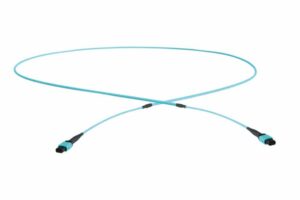
For 40G and 100G network deployments, parallel transmission architectures such as BASE-8 using MPO connectors provide a cost-efficient and quick-to-deploy solution.
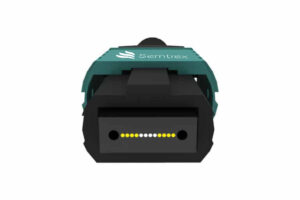
An MPO connector typically contains 12 fiber positions, with 8 fibers actively used in a BASE-8 configuration — 4 dedicated to transmission and 4 to reception. Each fiber carries 10G in a 40G setup or 25G in a 100G configuration.
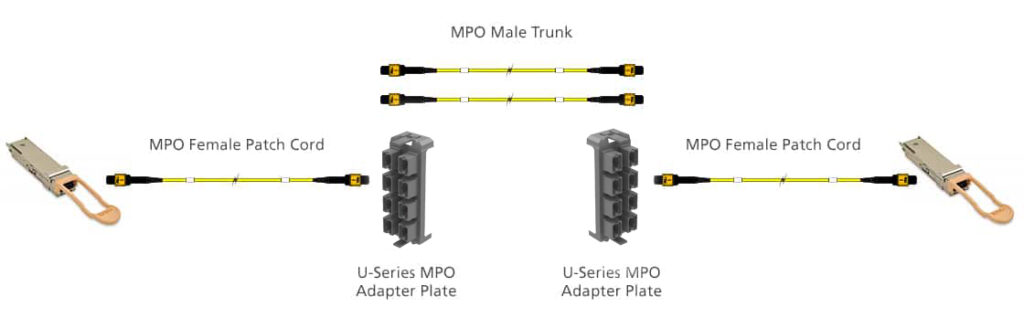
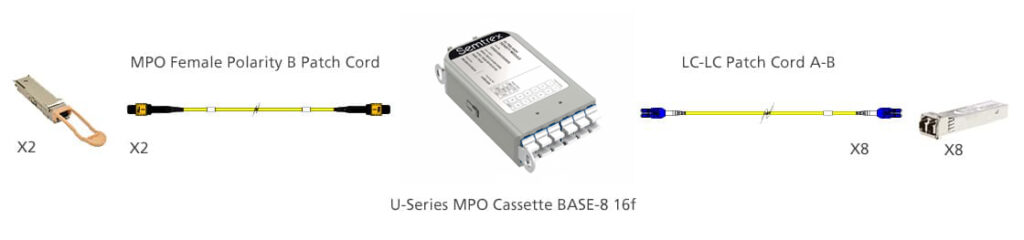
MPO cable assemblies are categorized based on polarity and connector gender. In BASE-8 applications, transceivers are manufactured with pins (male), meaning patch cords must be female, and Type B polarity is required to ensure proper signal alignment.
In the example channel configurations below, single-mode fiber is utilized due to its ability to support high data rates over longer transmission distances, making it ideal for modern data center environments.

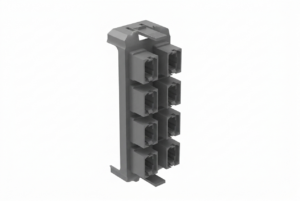
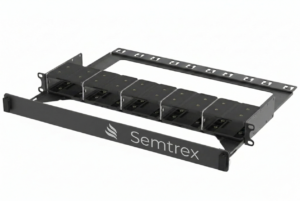
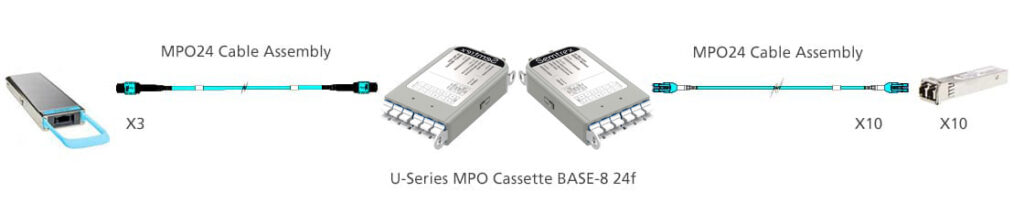
Conversion cassettes like these are used to transition from 40GbE to 10GbE or 100GbE to 25GbE applications. With this product, 2 x QSFP ports can be split into 8 x SFP ports with a full-front interface. All optical ports are positioned in front of U-Series cassettes providing convenient front access.
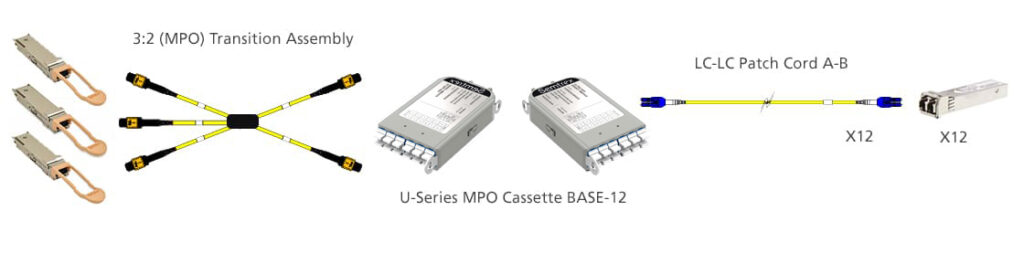
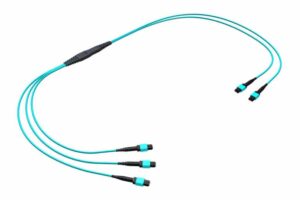
Transition assemblies allow for fibers in the existing installed trunks to be fully utilized for 40G or 100G parallel optics transmission (3 x QSFP pairs can be connected using 24-fiber MPO trunks).
Transition assemblies are offered in pre-set configurations allowing for the utilization of legacy Polarity A, B, or C Backbone MPO trunks in 40G or 100G networks, facilitating easy polarity management.
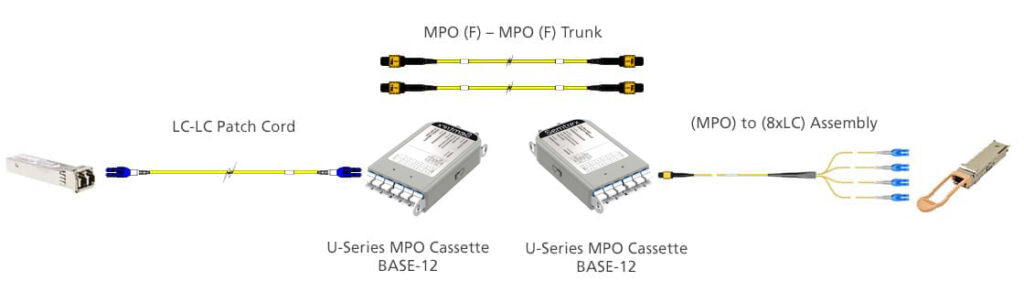
Transition MPO to LC breakout cable assemblies are used to convert from parallel to duplex transmission, allowing 1x40G to 4x10G or 1x100G to 4x25G conversion – a typical scenario is shown above.
| Speed | Ethernet Nomenclature | Ethernet Standard IEEE | Medium | Transceiver Form Factor | Connector Interface | Link Reach |
|---|---|---|---|---|---|---|
| 100GbE (100Gb/s) | 100GBASE-SR10 | 802.3ba-2010 (CL82/86) | Multimode Fiber (@850nm) | CXP | MPO (2×12) | OM3 – 100m OM4 – 150m |
| 100GBASE-PSM4 | proprietary (non-IEEE)(Jan 2014) | Single-mode Fiber (@1310nm) | QSFP28 CFP4 | MPO 12 | OS2-500m | |
| 100GBASE-CWDM4 | proprietary (non-IEEE)(Mar 2014) | Single-mode Fiber (WDM) | QSFP28 CFP2 CFP4 | LC Duplex | OS2-2km | |
| 100GBASE -SR2-BiDi (Bi-directional) | proprietary (non-IEEE) | Multimode Fiber (@850nm @900nm) (WDM) | QSFP28 | LC Duplex | OM3 – 70m OM4 – 100m | |
| 100G-SWDM4 | proprietary (non-IEEE)(Jun 2016) | Wide Band Multimode Fiber (SWDM) | SFP | LC Duplex | OM5 – 150m | |
| 100GBASE-LR4 | 802.3ba-2010 (CL88) | Single-mode Fiber (WDM) | QSFP28 CFP CFP2 CFP4 CPAK | LC Duplex SC Duplex | OS2 – 10km | |
| 100GBASE-SR4 | 802.3bm-2015 (CL95) | Multimode Fiber (@850nm) | QSFP28 CFP2 CFP4 CPAK | MPO 12 | OM3 – 70m OM4 – 100m | |
| 100GBASE-ER4 | 802.3ba-2010 (CL88) | Single-mode Fiber (WDM) | QSFP28 CFP CFP2 | LC Duplex SC Duplex | OS2 – 40km |
| Speed | Ethernet Nomenclature | Ethernet Standard IEEE | Medium | Transceiver Form Factor | Connector Interface | Link Reach |
|---|---|---|---|---|---|---|
| 40GbE (40Gb/s) | 40GBASE-SR4 | 802.3ba-2010 (CL82/86) | Multimode Fiber (@850nm) | CFP | MPO | OM3 – 100m OM4 – 150m |
| 40GBASE-LR4 | 802.3ba-2010 (CL82/87) | Single-mode Fiber (WDM) | CFP QSFP+ | LC Duplex | OS2 – 10km | |
| 40GBASE-ER4 | 802.3bm-2015 (CL82/87) | Single-mode Fiber (WDM) | QSFP+ | LC Duplex | OS2 – 40km |